Ecological provision across the regions of India as a function of local cultural capital
DOI:
https://doi.org/10.18335/region.v13i2.668Abstract
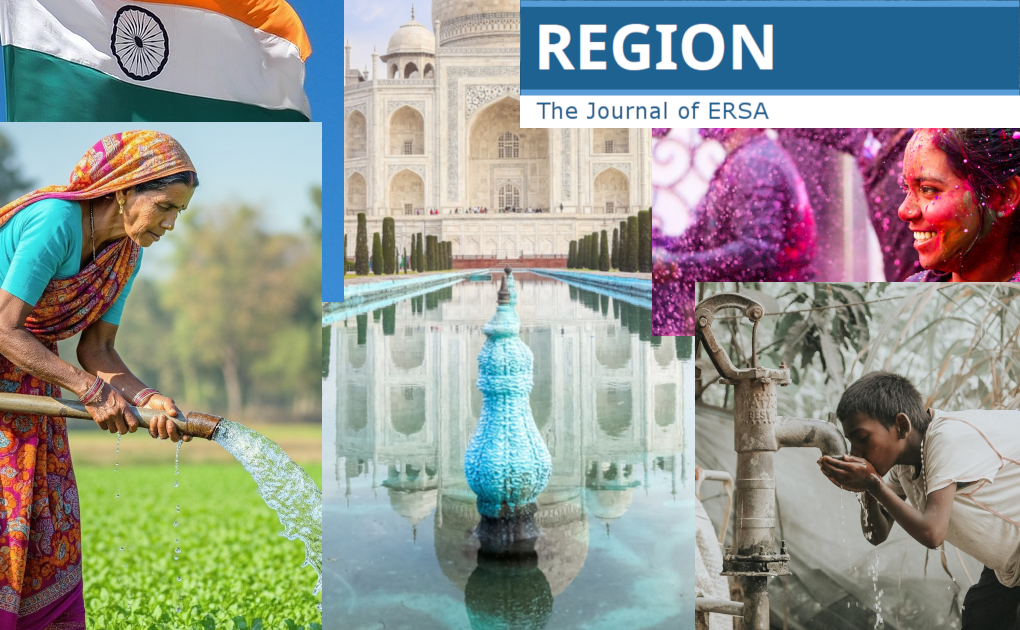
This paper aims to review the cultural reasons behind the different water access across the regions of India using the data from National Family Health Survey for the years 2019-2021 and combining it with the cultural data from the Survey on Literacy and Culture of India for the year 2014. I compiles the dataset that allows me to test the working hypothesis that is in the presence of economic controls. The local cultural capital plays a significant role in explaining which type of water source is predominantly used by households. In order to quantify the local cultural capital, the current study employs the Culture Based Development (CBD) paradigm and obtains the cultural heritage (CH) and living culture (LC) components for every region. In addition, cultural heritage and living culture are next used to calculate the local cultural entropy (CE). The results show that the cultural variables always matter yet using only CH and LC have inconclusive directions, while cultural entropy has a persistent positive association with the use of higher quality of sources of water.
References
Abdi H, Williams LJ (2010) Principal component analysis. Wiley interdisciplinary reviews: computational statistics 2: 433–459. https://doi.org/10.1002/wics.101
Banerjee A, Banerji R, Berry J, Duflo E, Kannan H, Mukerji S, Walton M (2017) From proof of concept to scalable policies: Challenges and solutions, with an application. Journal of Economic Perspectives 31: 73–102. https://doi.org/10.1257/jep.31.4.73
Banerjee A, Somanathan R (2007) The political economy of public goods: Some evidence from India. Journal of development Economics 82: 287–314. https://doi.org/10.1016/j.jdeveco.2006.04.005
Ben-Akiva ME, Lerman SR (1985) Discrete choice analysis: Theory and application to travel demand. MIT Press, Cambridge, MA
Biswas S, Adhikary M, Alam A, Islam N, Roy R (2024) Disparities in access to water, sanitation, and hygiene (WASH) services and the status of SDG-6 implementation across districts and states in India. Heliyon 10. https://doi.org/10.1016/j.heliyon.2024.e37646
Braeken J, Assen MA (2017) An empirical Kaiser criterion. Psychological methods 22: 450. https://doi.org/10.1037/met0000074
Camagni R (2008) Le ragioni del piano: Perché il divorzio fra liberalismo e pianificazione è insostenibile. Scienze Regionali 7: 101--122
Coffey D, Gupta A, Hathi P, Khurana N, Spears D, Srivastav N, Vyas S (2014) Revealed preference for open defecation. Economic & Political Weekly 49: 43
Das NK (2006) Cultural diversity, religious syncretism and people of India: An anthropological interpretation. Bangladesh e-journal of Sociology 3: 1–19. Available online at https://dhanak4humanity.wordpress.com/wp-content/uploads/2014/10/syncretic_communities_in_india.pdf
Gupta A, Spears D (2017) Health externalities of India's expansion of coal plants: Evidence from a national panel of 40,000 households. Journal of environmental economics and management 86: 262–276. https://doi.org/10.1016/j.jeem.2017.04.007
Gupta D (2000) Interrogating caste: Understanding hierarchy and difference in Indian society. Penguin Books India, DLF Cyber City, Gurgaon, India
Gurung R, Tirkey C, Takri KK, Diyali N, Choubey M, Rai R (2023) Determinants of access to improved drinking water and sanitation in India: Evidence from India Human Development Survey-II (IHDS). Water Policy 25: 980–995. https://doi.org/10.2166/wp.2023.083
Jadon AS (2025) The Indian knowledge system: Society, culture, traditions, celebrations, social practices, and norms. Indian Knowledge System & India: Educational Book 132: 8198110410
Jeuland M, Harshadeep N, Escurra J, Blackmore D, Sadoff C (2013) Implications of climate change for water resources development in the Ganges basin. Water Policy 15: 26–50. https://doi.org/10.2166/wp.2013.107
Ministry of Health and Family Welfare (2025) National family health survey (NFHS) data request portal. Available at: https://www.nfhsiips.in/nfhsuser/requesthomepage.php. Accessed October 9, 2025
Munshi K, Rosenzweig M (2016) Networks and misallocation: Insurance, migration, and the rural-urban wage gap. American Economic Review 106: 46–98. https://doi.org/10.1257/aer.20131365
Natrajan B (2011) The culturalization of caste in India: Identity and inequality in a multicultural age. Routledge. https://doi.org/10.4324/9780203805367
Ostrom E (1990) Governing the commons: The evolution of institutions for collective action. Cambridge University Press, Cambridge, UK. https://doi.org/10.1017/cbo9780511807763
Ostrom E (2000) Collective action and the evolution of social norms. Journal of Economic Perspectives 14: 137–158. https://doi.org/10.1257/jep.14.3.137
Samuelson PA (1954) The pure theory of public expenditure. The review of economics and statistics: 387–389. https://doi.org/10.2307/1925895
Torre A, Wallet F (2015) Towards new paths for regional and territorial development in rural areas. European Planning Studies 23: 650–677. https://doi.org/10.1080/09654313.2014.945812
Tubadji A (2012) Culture based development: Empirical evidence for Germany. International Journal of Social Economics 39: 690–703. https://doi.org/10.1108/03068291211245718
Tubadji A (2013) Culture based development -- culture and institutions: Economic development in the regions of Europe. International Journal of Society Systems Science 5: 355–391. https://doi.org/10.1504/IJSSS.2013.058466
Tubadji A (2020) Value-free analysis of values: A culture based development approach. Sustainability 12: 9492. https://doi.org/10.3390/su12229492
Tubadji A (2021) Ceteris paribus and fixed effects in regional and cultural economics. In: Suzuki S, Patuelli R (eds), A Broad View of Regional Science: Essays in Honor of Peter Nijkamp. Springer Singapore, Singapore, 175–198. https://doi.org/10.1007/978-981-33-4098-5_10
Tubadji A (2023) Culture based development in the regions of China. Journal of Economic Issues 57: 8–35. https://doi.org/10.1080/00213624.2023.2154531
Tubadji A (2025a) Cultural entropy, innovation, and growth. Politics & Policy 53: 70050. https://doi.org/10.1111/polp.70050
Tubadji A (2025b) Culture Based Development -- Modelling Cultural Bias in Economic Choice. Edward Elgar Publishing. https://doi.org/10.4337/9781035341108
Tubadji A, Angelis V (2023) Endogenous intangible resources and their place in the institutional hierarchy. Review of Regional Research 36: 1–28. https://doi.org/10.1007/s10037-015-0097-5
Tubadji A, Huang H, Webber DJ (2021) Cultural proximity bias in AI-acceptability: The importance of being human. Technological Forecasting and Social Change 173: 121100. https://doi.org/10.1016/j.techfore.2021.121100
Tubadji A, Jain Y, Asproudis E (2024) Culture based development and pro-circular-economy behaviour in India. Scienze Regionali 24: 203–236. https://doi.org/10.14650/107808.
Tubadji A, Nijkamp P (2015) Cultural gravity effects among migrants: A comparative analysis of the EU15. Economic Geography 91: 343–380. https://doi.org/10.1111/ecge.12088
Tubadji A, Pelzel F (2015) Culture based development: Measuring an invisible resource using the PLS-PM method. International Journal of Social Economics 42: 1050–1070. https://doi.org/10.1016/j.techfore.2021.121100
van Leeuwen ES, Nijkamp P (2006) The embeddedness of small enterprises within the rural local economy of small and medium sized towns. In: de Noronha Vaz T (ed), The New European Rurality. Routledge, London, UK. https://doi.org/10.4324/9781315238135
Weber M (1916) The Religion of India: The Sociology of Hinduism and Buddhism. Gyan Publishing House, New Delhi
Downloads
Published
How to Cite
Issue
Section


License
Copyright (c) 2026 Yashi Jain

This work is licensed under a Creative Commons Attribution 4.0 International License.
REGION is an open journal, and uses the standard Creative Commons license: Copyright We want authors to retain the maximum control over their work consistent with the first goal. For this reason, authors who publish in REGION will release their articles under the Creative Commons Attribution license. This license allows anyone to copy and distribute the article provided that appropriate attribution is given to REGION and the authors. For details of the rights authors grant users of their work, see the "human-readable summary" of the license, with a link to the full license. (Note that "you" refers to a user, not an author, in the summary.) Upon submission, the authors agree that the following three items are true: 1) The manuscript named above: a) represents valid work and neither it nor any other that I have written with substantially similar content has been published before in any form except as a preprint, b) is not concurrently submitted to another publication, and c) does not infringe anyone’s copyright. The Author(s) holds ERSA, WU, REGION, and the Editors of REGION harmless against all copyright claims. d) I have, or a coauthor has, had sufficient access to the data to verify the manuscript’s scientific integrity. 2) If asked, I will provide or fully cooperate in providing the data on which the manuscript is based so the editors or their assignees can examine it (where possible) 3) For papers with more than one author, I as the submitter have the permission of the coauthors to submit this work, and all authors agree that the corresponding author will be the main correspondent with the editorial office, and review the edited manuscript and proof. If there is only one author, I will be the corresponding author and agree to handle these responsibilities.